

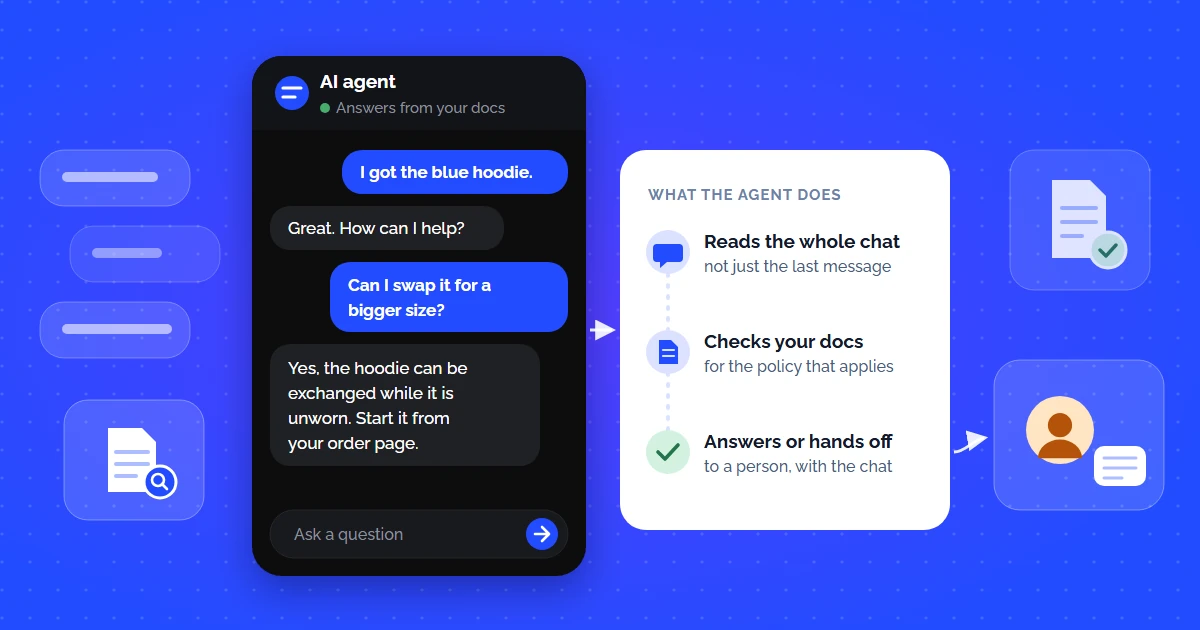
If you have been searching for "AI agents for customer support" or "best AI agents for customer support," you have probably noticed a fundamental shift in the industry. The old-school chatbots that ask "Did you mean billing or shipping?" are rapidly being replaced by agentic AI — intelligent systems that reason, act, and resolve customer issues autonomously.
According to Gartner, agentic AI will resolve 80% of common customer service issues without human agents by 2029. That is a forecast for 2029, not a rate to expect on day one: what an agent resolves today depends on how well your documentation covers what customers ask. This guide covers everything you need to know.
What Is Agentic AI for Customer Support?
Traditional chatbots follow pre-scripted decision trees. They map keywords to canned responses and fail the moment a customer asks something outside the script. Agentic AI is fundamentally different.
An AI agent is an autonomous system that can:
- Understand natural language — interpret customer intent, not just match keywords
- Reason through multi-step problems — chain together information from multiple knowledge sources
- Take actions — look up orders, trigger refunds, update accounts, or create tickets autonomously
- Decide when to escalate — intelligently hand off to a human when a situation requires empathy, negotiation, or policy exceptions
- Learn from interactions — improve accuracy over time based on resolution patterns
IBM reports that 42% of enterprise-scale companies (over 1,000 employees) have AI actively in use, and another 40% are exploring or experimenting with it.
Traditional Chatbot vs AI Agent vs Human Agent
Here is how the three approaches compare across the metrics that matter most:
| Capability | Traditional Chatbot | AI Agent (Agentic AI) | Human Agent |
|---|---|---|---|
| Understanding | Keyword matching | Semantic comprehension | Full comprehension |
| Response accuracy | Limited to scripts | RAG-grounded, high accuracy | High (varies by experience) |
| Availability | 24/7 | 24/7 | Business hours only |
| Concurrent conversations | Unlimited | Unlimited | 3–5 max |
| Multi-turn context | None — resets each turn | Full conversation memory | Full context |
| Cost per interaction | ~$0.01 | ~$0.05–$0.15 | $8.01 avg. on live channels (Gartner) |
| Empathy and nuance | None | Moderate (improving) | Excellent |
- 1Understand the goalParses what the customer is trying to achieve, not just which keyword they typed.
- 2Retrieve the factsPulls the relevant passages from your documentation and the customer's own account context.
- 3Take the actionCalls a permitted tool - look up an order, resend an invoice, open a ticket - inside a scoped permission set.
- 4Verify before replyingChecks the answer against the retrieved sources and refuses when they do not support it.
- 5Escalate cleanlyHands the conversation to a human with the transcript, the sources used and the actions already taken.
5 Core Capabilities of AI Support Agents
Autonomous Resolution
Resolve common tickets end-to-end without human intervention — password resets, order status, billing FAQs, and more.
Context Switching
Handle hundreds of conversations simultaneously while maintaining full context for each customer interaction.
Multi-Turn Memory
Remember what was said 10 messages ago. No more "Can you repeat your order number?" frustrations.
Smart Escalation
Detect frustration, policy edge cases, or VIP customers and route to the right human — with full chat history attached.
Continuous Learning
Improve over time as your knowledge base grows. Every new document or FAQ makes the agent more accurate.
How CustomerGPT Implements Agentic AI for Support
CustomerGPT is purpose-built as an agentic AI customer support platform. Unlike generic LLM wrappers, every response is grounded exclusively in your verified knowledge base using Retrieval-Augmented Generation (RAG). Here is the architecture:
- Knowledge Ingestion — Upload your website URLs, PDFs, DOCX files, or FAQ pages. CustomerGPT's parallel hierarchical parser indexes up to 1,000 pages on the Starter plan and up to 50,000 on Scale.
- Semantic Understanding — Customer queries are embedded and matched against your vectorized knowledge base using cosine similarity, ensuring contextually accurate answers.
- Guardrail Protection — Every response passes through multi-layered security guardrails that block prompt injections and jailbreak attempts.
- Human Handoff — When the agent detects a query it cannot resolve confidently, it escalates to your team via Slack, email, or any webhook-connected system.
// How CustomerGPT's AI Agent resolves a support query

Customer: "I ordered a blue hoodie last Tuesday but received
  a red one. Can I get a replacement?"

AI Agent (internal reasoning):
  → Intent: Product exchange / wrong item received
  → Knowledge lookup: Returns & Exchange Policy
  → Match: "Wrong item received → eligible for free replacement"
  → Action: Confirm order details + initiate replacement

AI Agent: "I'm sorry about the mix-up! I can see your order
  #4821 for the blue hoodie. Since you received the wrong color,
  you're eligible for a free replacement. I'll initiate the
  exchange now — you'll receive a prepaid return label via email
  within 2 minutes. Is there anything else I can help with?"

→ Resolution: AUTONOMOUS
→ Human involvement: NONE
Who Should Use AI Agents for Customer Support?
AI agents are not limited to enterprise — they deliver value across every business size:
- E-commerce stores — Handle order inquiries, returns, and product questions 24/7. See our deep dive on AI chatbots for e-commerce customer support.
- SaaS companies — Reduce onboarding friction and support ticket volume by answering product questions from your documentation instantly.
- Startups — Deliver enterprise-grade support without hiring a full support team. If you are evaluating your current tools, check out our guide on free Zendesk alternatives.
- Agencies — Automate front-line sales and support across multiple client accounts from a single platform.
The Bottom Line on AI Agents for Customer Support
80% by 2029 (Gartner Forecast)
Gartner forecasts that by 2029 agentic AI will resolve 4 out of 5 common service issues without a human. Your rate today depends on how well your docs cover what customers ask.
Sub-3-Second Responses
AI agents respond instantly, 24/7 — no queues, no hold music, no "we'll get back to you in 24 hours."
Lower Cost per Interaction
AI interactions cost $0.05–$0.15, while Gartner puts the average live-channel contact (phone, chat, email) at $8.01. Scale support without scaling headcount.
Ready to Deploy AI Agents for Your Support Team?
Set up your custom AI support agent in under 2 minutes with CustomerGPT. Train it on your website links, PDFs, or FAQs — no code required. Start resolving tickets automatically today.