

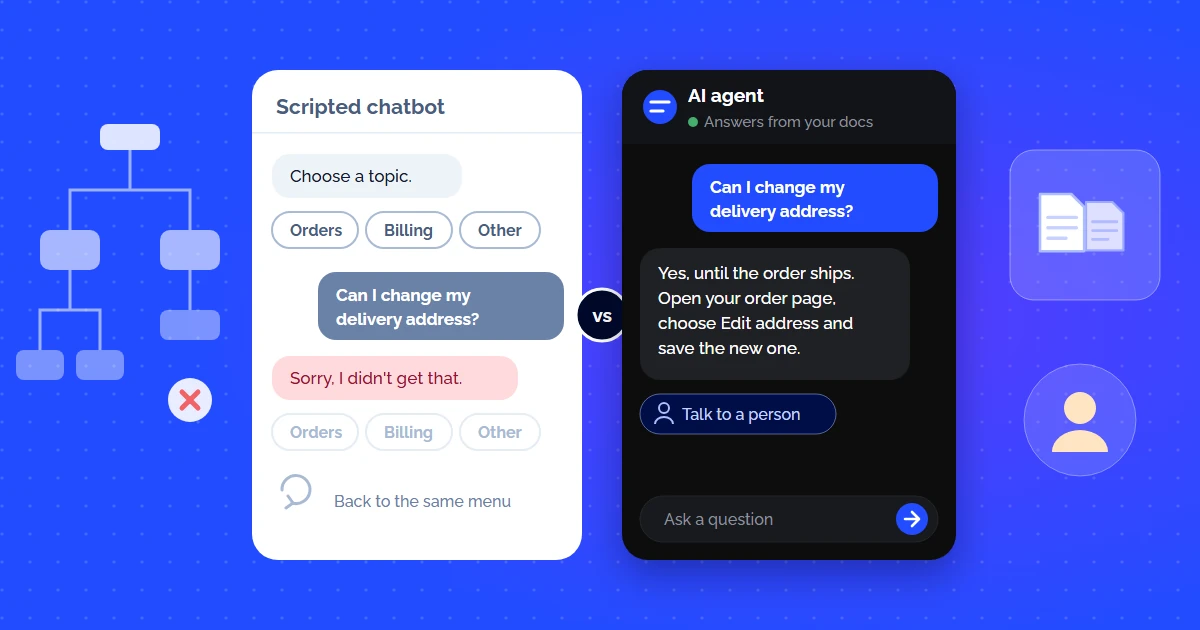
"Should I deploy a chatbot or an AI agent?" It is the most common question in customer support right now — and it is the wrong question. The terms have become so muddled by marketing that most buyers cannot tell the difference between a scripted chatbot, an AI chatbot, and an AI customer support agent.
This article clarifies the confusion once and for all. By the end, you will know exactly what each term means architecturally, when to use each, and why the most effective 2026 platforms blur the line between them.
Clear Definitions: 3 Levels of Customer Support Automation
Level 1: Rule-Based Chatbot
Follows scripted decision trees. Maps keywords to canned responses. Breaks the moment a customer asks anything outside the script. Not AI.
Level 2: AI Chatbot
Uses LLM + RAG to understand natural language and generate answers from your knowledge base. Can handle novel questions. Reads, understands, answers — but does not act.
Level 3: AI Support Agent
Everything Level 2 does, plus takes autonomous actions: looks up accounts, triggers workflows, processes refunds, creates tickets, and decides when to escalate. Reasons, acts, and resolves.
Head-to-Head: AI Chatbot vs AI Support Agent
| Capability | AI Chatbot | AI Support Agent |
|---|---|---|
| Answers knowledge-base questions | Yes | Yes |
| Understands natural language | Yes | Yes |
| Looks up customer accounts/orders | No | Yes (via API) |
| Triggers automated actions (refunds, ticket creation) | No | Yes (via webhooks) |
| Multi-turn conversation memory | Yes | Yes |
| Autonomous decision-making | No — answers only | Yes — reasons and acts |
| Smart escalation to humans | Basic (on request or no answer) | Advanced (emotion, VIP, policy edge cases) |
| Setup complexity | Low (minutes) | Medium (hours to days for integrations) |
| Cost | Lower | Higher (more infrastructure) |
AI chatbot
- Answers from documentation and FAQs
- Read-only: it can explain a refund policy
- Fails by saying the wrong thing
- Setup is content work
AI support agent
- Answers, then acts through permitted tools
- Write-capable: it can actually issue the refund
- Fails by doing the wrong thing, so scope its tools tightly
- Setup is content work plus a permission model
When to Use a Chatbot vs When You Need an Agent
Deploy an AI Chatbot when:
- Your primary goal is deflecting FAQ-style questions (pricing, features, policies, how-to guides)
- You do not need the bot to access external systems (no order lookups, no account changes)
- You are a small team that wants fast time-to-value with minimal configuration
- Your support volume is moderate (under 5,000 conversations/month)
Deploy an AI Support Agent when:
- You need the AI to look up customer-specific data (orders, subscriptions, account status)
- You want automated actions — refunds, ticket creation, password resets — without human intervention
- You handle high volume (>10,000 conversations/month) with repetitive resolution workflows
- You need sophisticated escalation logic (VIP detection, sentiment analysis, compliance routing)
Most teams should start with an AI chatbot and graduate to agentic capabilities as their needs grow. The platforms that let you do both — without ripping and replacing — are the ones worth investing in. Gartner predicts that by 2029, agentic AI will resolve 80% of common customer service issues without human intervention.
The Convergence: Why the Best Platforms Do Both
The "chatbot vs agent" divide is increasingly artificial. The most effective AI customer support platforms in 2026 combine both capabilities on a single foundation:
- Start as a chatbot — Answer knowledge-base questions with RAG-grounded accuracy from day one.
- Add agentic actions over time — Connect APIs to enable order lookups, ticket creation, and automated workflows as your team is ready.
- Unified knowledge layer — Whether the AI is answering a question or executing an action, it draws from the same verified knowledge base.
- Single escalation system — Chatbot-level queries and agent-level workflows both escalate through the same human handoff pipeline.
How CustomerGPT Bridges Chatbot and Agent
CustomerGPT is designed for exactly this progression. On day one, it is an AI chatbot for customer support you can deploy without code — paste your URL, get a live bot in 2 minutes. As your needs grow, you unlock agentic capabilities:
- Chatbot layer — RAG-grounded answers from your docs, PDFs, and web pages.
- Lead capture agent — Automatically collects visitor emails and routes qualified leads to your pipeline.
- Webhook actions — Connect to your CRM, helpdesk, or internal tools via webhook event triggers to enable automated actions.
- Human escalation — Configurable escalation to Slack, email, or any webhook-connected system with full conversation context.
Start as a Chatbot. Grow Into an Agent.
CustomerGPT takes you from zero to AI-powered customer support in one product — whether you need a simple FAQ chatbot today or a full autonomous agent tomorrow. No rip-and-replace required.