

Artificial intelligence in sales is no longer just hype. According to Salesforce's 2026 State of Sales report, 87% of sales organizations now use some form of AI. But there is a massive gap between experimenting with AI tools and actually moving your bottom line.
If you have ever wondered why some teams close deals effortlessly while others drown in admin work, it usually comes down to three research-backed factors. Here is why AI sales automation matters for your business right now — and how CustomerGPT helps you put it to work.
Reason #1: Reps Spend 60% of Their Time Not Selling
Every sales manager secretly suspects it, and Salesforce's 2026 State of Sales report confirms it: the average seller spends only 40% of their time actually selling, and Gen Z reps just 35%. The survey covered 4,050 sales professionals.
Where does the other 60% go?
- Manual CRM data entry — filling out contact fields and updating deal stages
- Manual lead qualification — cold-calling contacts and sorting inbound forms one by one
- Drafting repetitive emails — copy-pasting follow-ups, reminders, and check-ins
- Reporting and forecasting — assembling pipeline analytics and revenue numbers
- Internal syncs — sitting in status meetings and team coordination calls
According to Gartner, AI tools save sellers an average of 4.8 hours every single week — more than half a working day given back to each seller.
How CustomerGPT Gives Your Team Their Time Back
Instead of forcing reps to act like human data processors, CustomerGPT automates the front line:
- Instant Answers 24/7 — CustomerGPT responds to visitor questions in seconds using your exact documentation, pricing, and FAQ.
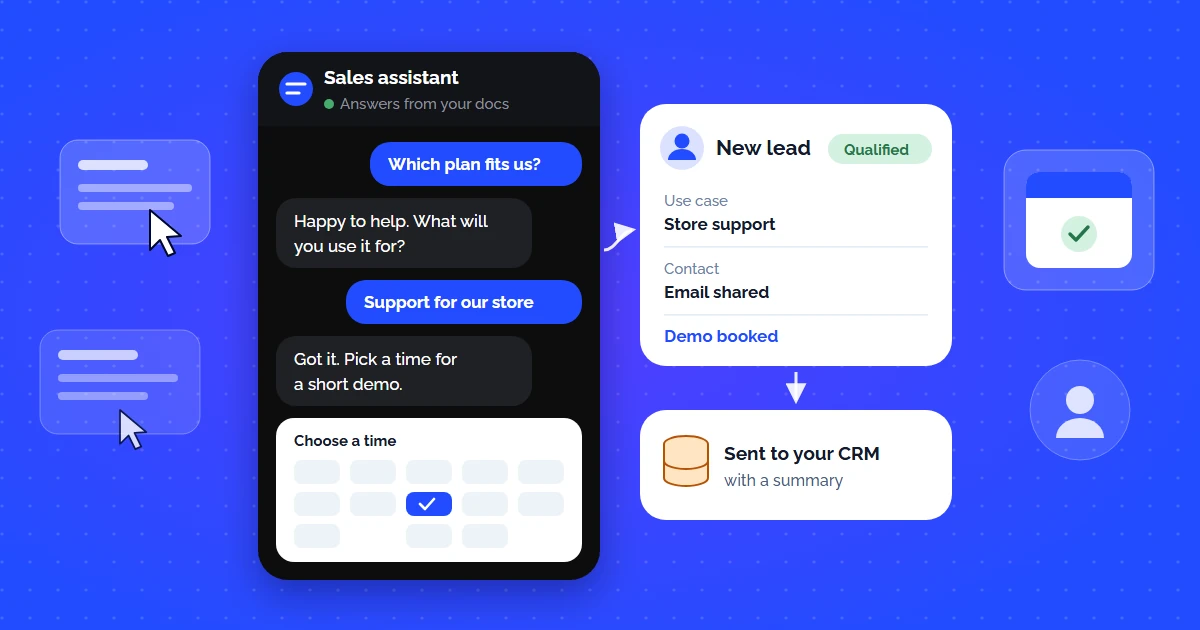
- Automated Qualification — The AI naturally asks visitors key qualifying questions (budget, timeframe, team size) and tags lead intent before a human steps in.
- Tailored Context — No generic bot templates. CustomerGPT retrieves precise answers grounded in your uploaded knowledge base.
- Smart Human Handoff — When a high-intent prospect wants a demo or custom quote, CustomerGPT alerts the right account executive with the complete chat history attached.
Reason #2: Speed to Lead — Slow Replies Lose Qualified Leads

Back in 2011, a landmark study by Harvard Business Review uncovered a shocking stat: companies that answered a web lead within 30 days took 42 hours on average, and 23% of companies never replied at all.
Analyzing over 15,000 leads and more than 100,000 call attempts, the Lead Response Management study found that the chance of reaching a lead drops more than tenfold within the first hour, and that the odds of qualifying it fall 21-fold when the first call comes after 30 minutes instead of 5 minutes.
Yet most sales teams still miss this critical 5-minute window because leads come in after hours, over weekends, or while reps are stuck in meetings.
| Metric | Standard Industry Benchmark | Source |
|---|---|---|
| Average business lead response time | 42 hours | Harvard Business Review |
| Companies that never respond at all | 23% | Harvard Business Review |
| Odds of qualifying a lead contacted within 1 hour vs. an hour later | ~7x higher | Harvard Business Review |
| Odds of qualifying a lead, 5 min vs 30 min | 21x higher | MIT / InsideSales.com |
How CustomerGPT Eliminates Response Bottlenecks
CustomerGPT answers inbound questions the moment they arrive, without burning out your sales team:
- 24/7 Availability — Operates around the clock so late-night website visitors never go cold.
- Proactive Invitation — Invites visitors to chat on one page you pick, such as pricing: you set the page path, how many seconds they stay before it appears, and the message. It shows once per browser session, and visitors can dismiss it.
- Instant Pre-Qualification — Asks key questions upfront so your sales reps get warm, structured leads rather than blank inquiry forms.
- Seamless Handoff — Escalates high-intent buyers directly to rep calendars or Slack channels instantly.
// Live conversation flow with CustomerGPT

CustomerGPT Agent: "Hi!  Notice you're comparing our Enterprise
  plans. What's the main feature your team needs right now?"

Visitor: "We need SOC2 compliance and Slack sync for ~50 reps."

CustomerGPT Agent: "Both SOC2 compliance and native Slack sync come
  standard on Enterprise. Would you like to pick a 15-min slot with
  our solutions engineer today?"

→ Lead tagged: HIGH INTENT (Enterprise / SOC2)
→ Account executive receives Slack ping + chat summary
Reason #3: The ROI Reality — 3.7x Average Return on Generative AI

An IDC study commissioned by Microsoft (more than 4,000 business leaders, November 2024) found that companies earn an average return of 3.7x for every $1 invested in generative AI across business functions, with the top leaders reporting an ROI of $10.3. Sales is one of those functions, not a separate benchmark.
Here is the catch: Gartner also found that 72% of sales organizations report low reinvestment of those time savings into high-value sales activities. In its survey of 210 sales leaders, organizations that reinvest saved time into high-impact sales activities were 2.2x more likely to exceed customer growth goals and 3.1x more likely to exceed lead-to-opportunity conversion goals.
CustomerGPT bridges this reinvestment gap by keeping your human sales reps focused strictly on closing:
- AI handles front-line engagement — top-of-funnel qualification runs automatically 24/7
- Reps focus exclusively on closing — spend time only with warm, qualified buyers
- Zero data loss — every conversation detail is logged and categorized automatically
- Infinite scale — handle traffic spikes without adding headcount
Comparison: Manual Sales vs AI Sales with CustomerGPT
| Dimension | Traditional Manual Sales | CustomerGPT AI Sales |
|---|---|---|
| Lead response time | 42 hours average (HBR, 2011) | Seconds, at any hour |
| Coverage & availability | Standard business hours | 24/7/365 continuous |
| Simultaneous chats | 3–5 max per rep | Unlimited concurrent chats |
| Lead qualification speed | 15–30 minutes per lead | Under 2 minutes |
| Scaling cost | Linear headcount costs | Predictable subscription |
| Response consistency | Varies by individual rep | Grounded in your own docs |
Putting AI Sales to Work for Your Business
To wrap it up, AI sales automation delivers three clear wins:
4.8 Hours Reclaimed
Gartner's 2026 survey: AI saves sellers nearly five hours a week. Reinvest them in selling, not more admin.
Sub-3-Second Response
Engage website leads while buying intent is at its peak, before the odds of qualifying them start to fall.
3.7x Average Return (IDC)
IDC's figure for generative AI across business functions. Reinvest AI-saved hours into closing deals to capture it.
As McKinsey pointed out in their global AI research, the biggest wins don't come from tacking AI onto broken workflows — they come from redesigning your sales process around AI speed and precision.
Ready to Automate AI Sales?
Set up your custom AI sales agent in under 2 minutes with CustomerGPT. Ground it on your website links, PDFs, or FAQs, and start turning website visitors into qualified pipeline today.