
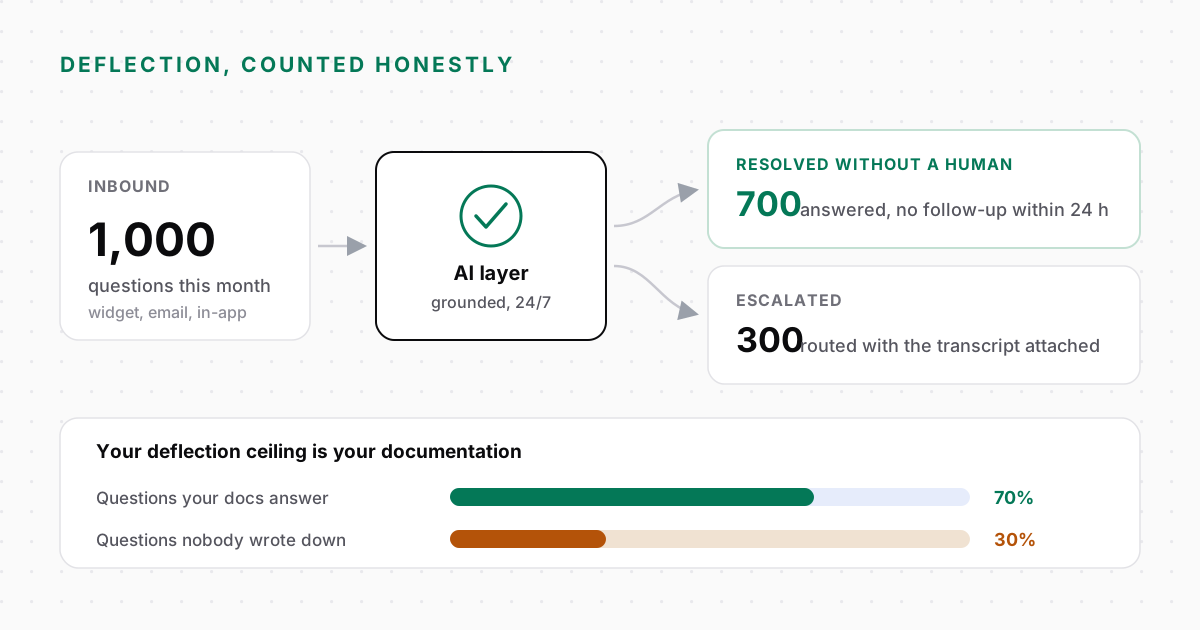
Deflection is the metric most often quoted and least often defined. Vendors count a conversation as deflected the moment the widget answers; customers count it as deflected only if they never had to ask again.
Before optimising the number, it is worth agreeing what would make it true.
Deflection Is a Measurement Problem First
The same month of traffic can produce, for example, a 40% or an 85% deflection rate depending purely on the definition. Pick the strict one — it is the only version that correlates with your team's workload actually going down.
- Not deflected: the assistant replied — A reply that sent the customer to email five minutes later deflected nothing.
- Not deflected: the customer closed the widget — Abandonment and satisfaction look identical in the logs, and they are not the same event.
- Deflected: answered, and no contact within 24 hours — The follow-up window is what makes the number honest.
- Deflected: escalated but resolved faster — A conversation the assistant triaged and handed over with full context is a partial win worth counting separately.
Where the Deflectable Volume Actually Is
Every support inbox has a long tail that nobody can automate and a fat head that almost anybody could. Start by measuring the head.
Illustrative mix for a subscription business, not a measurement of a specific account. Run this breakdown on your own last 90 days before setting a target.
Your Deflection Ceiling Is Your Documentation
A grounded assistant cannot answer what nobody wrote down. This is the single biggest determinant of the number you will reach, and it is entirely within your control.
Documentation work that moves deflection
- Write down the answers currently living only in agent replies
- Give every rule its own heading, so it retrieves as a whole
- State edge cases explicitly instead of implying them
- Cover the questions that only appear during onboarding
- Remove or clearly mark superseded pages
- Re-index on publish, so corrections take effect immediately
- Review the weekly “could not answer” list as a content queue
Measuring It Honestly
Four numbers, reviewed together. Any one of them alone can be gamed by making the assistant more evasive or more talkative.
- Deflection rate — Answered with no human contact within 24 hours, as a share of all conversations.
- Escalation rate and reason — Grouped by cause, this is your content backlog rather than a failure metric.
- Satisfaction on AI-resolved conversations — Tracked separately from human-resolved ones, or the average hides a problem.
- Repeat-contact rate — The number that catches an assistant that is closing conversations without actually resolving them.