
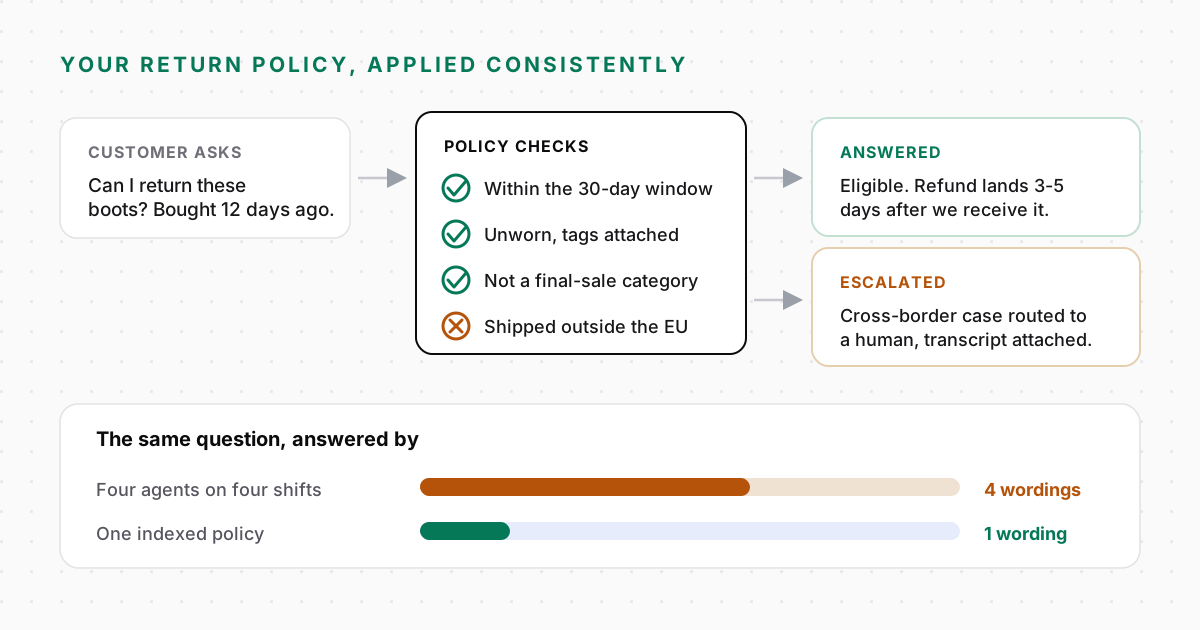
Returns questions escalate faster than any other support topic, because the customer is already mildly unhappy before they open the chat. They are not asking out of curiosity — they are asking whether they are about to lose money.
That makes consistency the whole game. A returns policy answered four different ways by four different agents is a policy that does not really exist.
Why Refund Questions Go Wrong
The policy is usually fine. What fails is its delivery: the rules live in three places, the edge cases live in someone's head, and the wording shifts depending on who replies.
- The policy is scattered — Window length on one page, condition requirements in the terms, category exclusions on the product page.
- The edge cases are undocumented — Sale items, bundles, gift orders and cross-border returns are exactly the cases customers ask about.
- Refund timing is a two-part answer — Your processing time plus the card issuer's settlement time. Quoting only the first one invites a follow-up ticket.
- Tone under pressure varies — A tired agent at the end of a shift writes a different “no” than a fresh one at the start.
Policy in people's heads
- Four agents, four phrasings of the same rule
- Edge cases resolved by improvisation
- Refund timing quoted without the issuer's window
- New starters take weeks to answer confidently
Policy indexed once
- One wording, taken from the policy page
- Edge cases answered because they were written down
- Both halves of the refund timeline stated every time
- New starters read the same answers customers get
Encode the Policy Once, Answer It Everywhere
Writing the policy for retrieval is different from writing it for a lawyer. Each rule needs to survive being read on its own, without the paragraph above it.
What your indexed policy must state explicitly
- The return window, and what starts the clock
- Condition requirements: tags, packaging, wear
- Categories that cannot be returned at all
- Who pays return shipping, in each scenario
- Refund timing: your processing plus the issuer's settlement
- How exchanges differ from refunds
- Cross-border and duty-paid return handling
- What happens to a return that arrives outside the window
A Returns Conversation That Ends Without a Ticket
Can I return these boots? I bought them 12 days ago.
Yes — you are inside the 30-day window, and unworn footwear with tags is returnable. Start it from your account page and we email a prepaid label.
When do I get the money back?
We refund within 2 working days of the return arriving, then your bank takes another 3 to 5 to post it. So 5 to 7 working days from when it reaches us.
Guardrails: What the Assistant Must Never Decide Alone
Returns is the workflow where an over-eager assistant costs real money. The boundary should be explicit in the system prompt and tested before launch.
- No exceptions to the policy — “I can make an exception this once” is a promise your team then has to honour. Only a human grants it.
- No refund date it cannot verify — Quote the policy window, never a specific date for a payment it cannot see.
- Disputes and chargebacks go straight to a person — By the time a customer uses those words, the conversation is a commercial one.
- Damaged and faulty items are a separate path — These usually carry statutory rights that differ from a voluntary returns policy, and they deserve a human read.