
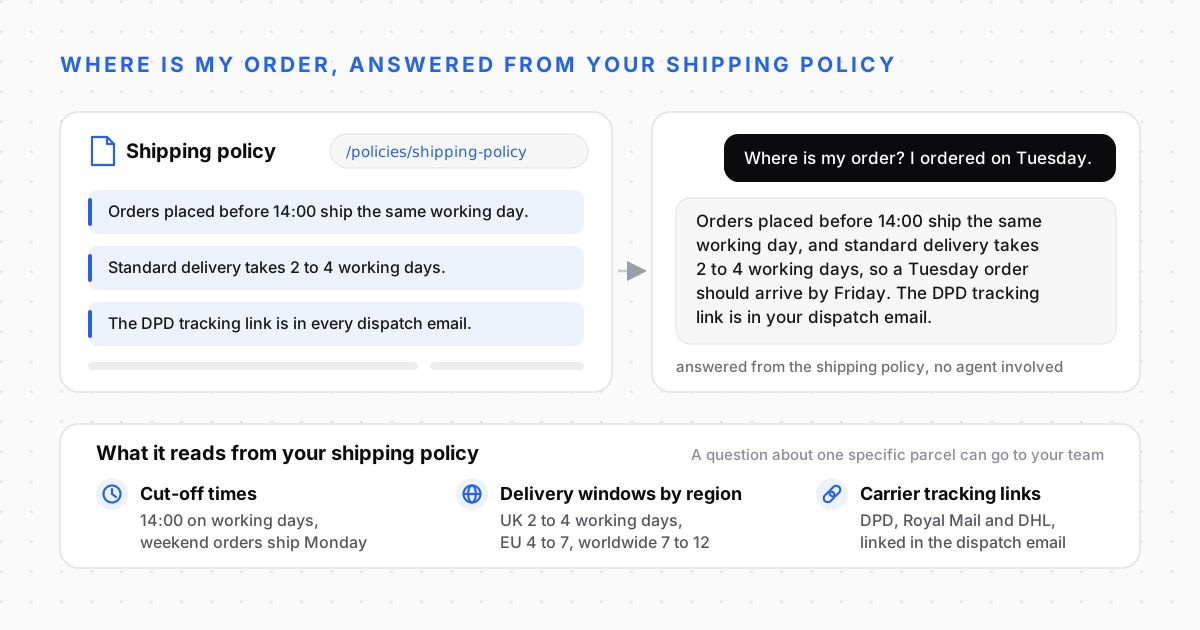
“Where is my order?” is the most predictable question in retail support and the least rewarding one to answer. The information already exists — in the carrier feed, in your shipping matrix, on the tracking page the customer may not have found. What is missing is somebody, or something, willing to say it out loud at the moment the customer asks.
This is what makes order tracking the highest-value first workflow to automate: high volume, low ambiguity, and an answer that is already written down somewhere.
Why Order-Status Questions Dominate Your Inbox
WISMO tickets are not a sign of a broken logistics operation. They are a sign that the customer is anxious and the tracking page is not reassuring them. Four things drive the volume.
- The tracking page answers “where”, not “when” — A carrier scan history is a log, not a promise. Customers want a delivery date, and most tracking pages bury or omit it.
- Carrier updates lag physical reality — A parcel can sit at “in transit” for two days while moving perfectly normally. That silence is what generates the ticket.
- One order produces several checks — The same customer checks after ordering, after the dispatch email, and again on the promised day — each one a chance to give up and email you.
- International orders add a whole second question — Customs, duties and regional carrier handoffs turn a simple delivery estimate into a policy question your tracking page never addresses.
What the Assistant Needs Before It Can Answer
Accuracy here is entirely a matter of what you index. An assistant that has your carrier links but not your cut-off times will answer confidently and wrongly about a Friday afternoon order.
Index these before you launch
- Delivery estimates by region and shipping method
- Order cut-off times, including weekends and holidays
- Carrier tracking portal links, per carrier
- Customs, duties and import handling by destination
- What happens to a delayed, lost or refused parcel
- Split-shipment and backorder rules
- Address-change and delivery-redirect policy
What a Good Order-Status Answer Looks Like
The shape matters as much as the content. A useful reply leads with when the parcel should arrive, says where the tracking link is, and offers the next step — in that order, because the customer stops reading after the first sentence.
Where is my order? I ordered on Tuesday.
Orders placed before 14:00 ship the same working day, and standard delivery takes 2 to 4 working days, so a Tuesday order should arrive by Friday. The DPD tracking link is in your dispatch email.
Nobody will be home. Can it go to a neighbour?
Yes — DPD lets you redirect to a neighbour or a pickup point from the tracking link up until the van is loaded. After that it comes back to us and we redeliver the next working day.
Where the Assistant Should Stop
Order tracking is safe to automate precisely because the boundary is easy to draw. Everything that involves money moving, or a promise you cannot verify, belongs to a person.
- Never invent a delivery date — If the carrier has not committed to one, say what is known and offer the escalation.
- Never approve a goodwill refund for a delay — That is a commercial decision with a cost attached, and it should have a human name on it.
- Hand over lost-parcel claims immediately — These are emotionally loaded and often have an insurance process behind them.
- Escalate anything touching a fraud or chargeback flag — The assistant should not confirm order details on a flagged account at all.
How to Tell Whether It Is Working
Two numbers are enough in the first month, and both come from data you already have.
- Share of order-status conversations that end without a human — Measure it as no agent reply and no follow-up contact within 24 hours — an answer the customer immediately re-asked is not a resolution.
- Order-status tickets per hundred orders — This normalises for growth. If order volume doubles and this ratio holds, deflection is genuinely absorbing the increase.